Collezione Fondazione Stelline
BOBO PICCOLI
Flooring of Palazzo delle Stelline
Milan
1973-1978
Seminato in multi-coloured marble
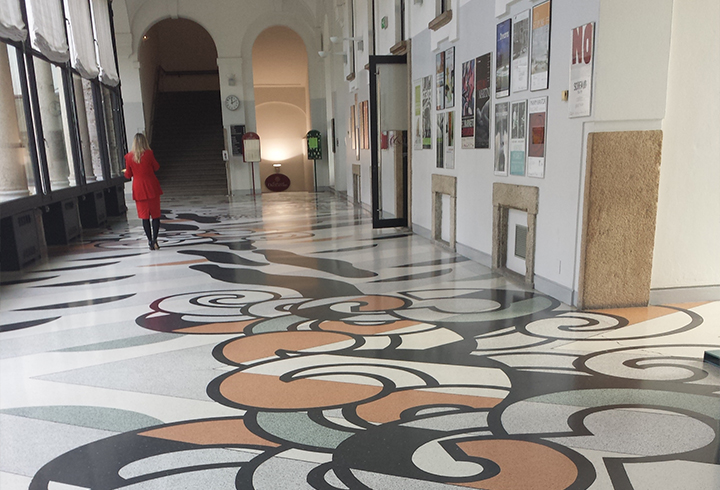
More than 1,500 square metres of the monumental floor at the Fondazione Stelline were created by Bobo Piccoli, a multifaceted artist active as a painter, sculptor and designer, between 1973 and 1978, making it one of the building’s most emblematic features.
The floor, made of polychrome marble mosaic and Venetian-style seminato, was begun in 1973, as indicated by the signature and date set into the floor at the building’s entrance, and completed in 1978.
As an artist and painter, Bobo Piccoli was deeply committed to the idea of a synthesis of the arts. The iconographic, zoomorphic and phytomorphic motifs of the floor are also found in the artist’s paintings and drawings from the 1970s. Several of his works are held at the Museo del Novecento, having come from the Boschi-Di Stefano Collection.
Plants, leaves, flowers, birds and insects clearly evoke Surrealist imagery, with swirling movements and biomorphic undulations, while also recalling the tradition of classical mosaics.
The work characterises the entrance portico on the ground floor, with references to its motifs extending to the upper floors of the building.
Bobo Piccoli (Milan, 1927–1981) grew up in an intellectual family whose home was frequented by Mario Sironi, Carlo Carrà, Giuseppe Ungaretti, Salvatore Quasimodo and many other artists. He studied painting and fresco with Achille Funi, Carlo Carrà and Aldo Carpi at the Accademia di Belle Arti di Brera, and in 1946 joined the Manifesto of Realism.
From the 1950s onwards, he collaborated with architects and designers, developing a research into the synthesis of the arts and the role of light. His works are held in the Boschi-Di Stefano Collection and at the Museo del Novecento.
In 1968, Piccoli began working with FontanaArte, for which he created the Re e Regina pair of lamps and the Clessidra picture lamps. His interventions for iconic architectural projects include the Petrolchimico complex in Brindisi (1959), the Palazzo delle Stelline in Corso Magenta, Milan (1972), the Centro Civico in Pieve Emanuele (1980), and the Piazza del Comune in Cislago (1981).