MAGEC / THE DESERT
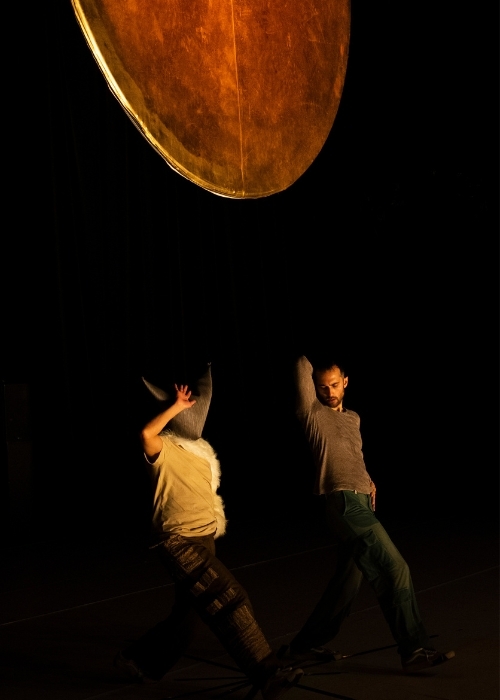
Throughout his choreographic practice, Radouan Mriziga explores the relationship between the body, knowledge, and landscape, weaving together artistic practices and cultural forms of knowledge. Magec / the Desert investigates vast, arid landscapes, revealing their wisdom and rethinking the relationship between human beings and nature. From the Sahara to the steppes of Central Asia, the desert emerges as a space for reflection, where humanity’s smallness becomes apparent and myth, literature, and cultural knowledge take shape.
Radouan Mriziga’s choreography approaches the desert not as an empty void, but as a geography of knowledge that calls for humility and reciprocity rather than domination. The work explores the desert’s rhythms, ecologies, and systems of knowledge. Drawing inspiration from the craftsmanship, music, and embodied practices of desert cultures, it investigates harmony and interconnectedness.
Mriziga’s collaborative practice intertwines rhythm, text, movement, and sound into a polyphony of perspectives. Like the layered landscapes of the desert, the performance resists uniformity, offering a rich sensory and intellectual experience. Magec / the Desert invites audiences to slow down, engage with the intelligence of nature, and reconnect with what is essential.
Throughout his choreographic practice, Radouan Mriziga explores the relationship between the body, knowledge, and landscape, weaving together artistic practices and cultural forms of knowledge. Magec / the Desert investigates vast, arid landscapes, revealing their wisdom and rethinking the relationship between human beings and nature. From the Sahara to the steppes of Central Asia, the desert emerges as a space for reflection, where humanity’s smallness becomes apparent and myth, literature, and cultural knowledge take shape.
Radouan Mriziga’s choreography approaches the desert not as an empty void, but as a geography of knowledge that calls for humility and reciprocity rather than domination. The work explores the desert’s rhythms, ecologies, and systems of knowledge. Drawing inspiration from the craftsmanship, music, and embodied practices of desert cultures, it investigates harmony and interconnectedness.
Mriziga’s collaborative practice intertwines rhythm, text, movement, and sound into a polyphony of perspectives. Like the layered landscapes of the desert, the performance resists uniformity, offering a rich sensory and intellectual experience. Magec / the Desert invites audiences to slow down, engage with the intelligence of nature, and reconnect with what is essential.